
Your Amazon Listings Have Content Gaps. Here's How to Find the Ones That Are Costing You Sales
Amazon just cut product titles to 75 characters. Here's how to audit listings for image, video, and A+ content gaps, and which ones to fix first.

On July 27, 2026, Amazon began enforcing a 75-character cap on product titles, down from a working limit of roughly 200. Brand-controlled text on the listing shrank by more than half in a single afternoon.
At the same time, most listings are thin where it now counts most. In a scoring pass across more than 500,000 manufacturer products at 50 retailers, ChannelSight found that only 40% of products carry more than two images and just 15% carry any video at all.
The persuasion load on Amazon moved to images, video, and A+ content in the same quarter that most brands still cannot say which of their listings are short on any of it.
An Amazon content audit compares each of your listings against the products shoppers in that category already buy, then reports where your content matches the benchmark and where it trails.
It looks at four surfaces: product images, brand video, creator video, and A+ content. The output is a ranked list of listings, not a best-practices checklist.
TL;DR
- 📉 Amazon cut product titles to 75 characters on July 27, 2026, with a new 125-character Item Highlights field below. Less text means visuals carry more of the sale.
- 🖼️ 61% of shoppers say images and video are the single biggest factor in whether they complete a purchase, ranking above description, reviews, and price in Salsify's 2026 survey of nearly 3,000 shoppers.
- 📊 Only 15% of products carry video across 50 retailers, but 92% of those same products already had a video sitting in the brand's PIM. Most image gaps are a publishing failure, not a production failure.
- 💰 Amazon says Basic A+ Content can raise sales by up to 8%, and Premium A+ by up to 20%. A missing A+ module is one of the few gaps with a vendor-published number attached.
- 🎯 The gap Cohley closes is the one no PIM contains: creator video and real-use imagery. Over 55% of reviews submitted through Cohley include a UGC image, and none of that content exists in a brand asset library until someone generates it.
Why does Amazon listing content matter more now than it did last quarter?
Because Amazon just took away half of your text. The 75-character title cap took effect July 27, 2026 in every category except media, and Amazon added a separate 125-character Item Highlights field below the title to absorb some of what no longer fits.
The net effect on total indexable characters is close to flat. The net effect on persuasion is not. A shopper scanning search results now sees a shorter title and the same image. A shopper on the detail page reads less and looks more.
That shifts weight onto the four surfaces a brand still fully controls: the image stack, brand video, creator video, and A+ content. Bazaarvoice's 2026 research found 97% of consumers consult multiple sources before buying, which means the listing is rarely the first thing a shopper sees and almost always the last.
If your listing is the final stop and it has three images and no video, you are asking a shopper to finish a decision with less information than the competitor one row over.
What does an Amazon content audit actually check?
It checks four content surfaces per ASIN, then compares each against the category's top sellers. The point is not to copy top sellers or to claim their content caused their sales. It is to find where the presentation differs, and by how much.
What the audit checks on each listing
- Product imagesDoes the listing meet the category median, and how large is the deficit?Shoppers cannot touch the product. Images cover benefit, use case, scale, and difference. 80% of product images across retailers are too small to zoom.
- Brand videoIs there polished product or brand storytelling on the listing?Answers "what is this and why does it exist" in under 30 seconds. Only 15% of products carry any video.
- Creator videoIs there relatable, experience-led content showing real use?Shoppers are 3.1x more likely to convert when they engage with visual UGC on retailer networks.
- A+ contentDoes the PDP have comparison, education, and brand context modules?Amazon's own figure is up to 8% sales lift for Basic and up to 20% for Premium.
Two of these are surfaces a brand can usually fill from existing assets. Two are not. That distinction matters more than the audit itself, and it comes up again below.
How do you benchmark a listing against the products shoppers already choose?
You place the listing in a relevant category, compare its content against that category's top sellers, and report the delta. The audit does this per ASIN, then rolls it up to the storefront.
The rollup is the part most brands have never had. A single listing report tells you one listing is thin. A storefront view tells you whether thin creator video is an isolated miss or a catalog-wide pattern, which is the difference between a one-off fix and a production plan.
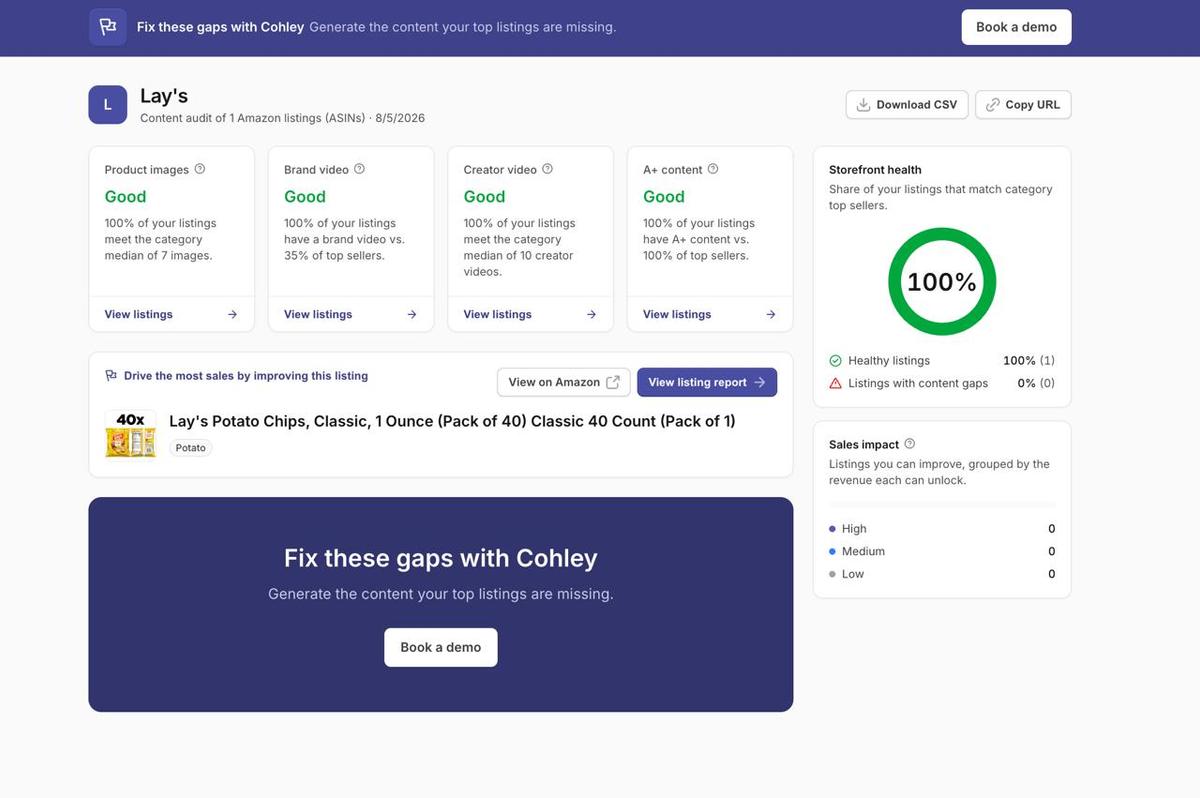
A useful read of the storefront view is not "what is my score." It is "how many of my listings share the same gap." One listing missing creator video is a task. Sixty listings missing creator video is a brief.
Why you should not optimize every listing equally
The standard Amazon content advice is a universal checklist: seven images, one video, A+ on everything. Applied across a 200-ASIN catalog, that is a year of work with no order of operations, which is why it usually turns into no work at all.
The unit of work is not the listing. It is the gap, weighted by how much that listing matters commercially.
The workflow:
- Find listings with one or more meaningful content gaps.
- Weigh each listing's relative commercial importance to your business.
- Group the opportunities by expected impact.
- Start with important listings that have the clearest fixable gaps.
- Export or share the findings so ecommerce and content teams work the same list.
A decision frame for step three:
How to prioritize what you fix
- HighCommercially important listing, several major gapsFix first. Biggest delta, clearest payoff.
- MediumMeaningful listing, one or two gapsQueue behind High. Often a single asset type.
- LowLimited commercial opportunity, or already close to benchmarkBatch into a later production cycle.
- SkipAt or above the category benchmarkLeave it alone. Not every listing needs work.
That last row is the one teams skip, and it is where content budgets quietly go to die. A listing already matching its category on all four surfaces does not get better because you added an eighth image to it.
Is your content gap a production problem or a distribution problem?
Ask this before you brief anything. The honest answer is often telling.
In the ChannelSight scoring pass, only 40% of products had more than two images live and 15% had video. But 92% of those same products already had two or more images and at least one video available in the brand's product information management system. The assets existed. They never made it to the retailer.
As ChannelSight's Madalina Plesoiu put it in that research, brands invest in asset libraries and brand sites, and the depth of that media does not always reach retail.
So the first move after an audit is a five-minute check, not a brief:
- Product images and brand video: check the PIM and the brand DAM first. If the asset exists, this is a syndication and ops problem. Fixing it costs a workflow, not a production budget.
- A+ content: you may already have the raw imagery and copy. Building the module is design work against existing assets.
- Creator video and real-use imagery: almost never in the PIM. Nobody's asset library contains 30 people filming themselves using your product in their own kitchens. This is net-new production by definition.
That last category is the gap worth paying to close, and it is the one that compounds. Salsify's 2026 research found 57% of shoppers rate ratings, reviews, and UGC as the most important element for completing a purchase, and Bazaarvoice measured a 144% conversion lift when shoppers engage with reviews. Neither is something you can pull from a folder.
How do you turn the audit into a content production plan?
Finding the gap is only useful if the team can close it. Once the audit names the priority listings, the work is mapping each gap type to a content action, then generating against it in batches rather than ASIN by ASIN.
Turning audit findings into content actions
- Too few product imagesAdditional lifestyle, use-case, detail, and instructional assetsCreator and professional photography, briefed once and produced across ASINs
- No brand videoOne concise product or brand-led videoProfessional video briefs
- Limited creator videoDemonstrations, testimonials, routines, real-world useCreator video for Amazon PDPs, sourced from vetted creators with rights included
- Missing A+ contentVisual and educational assets for richer PDP modulesImagery and video generated for the modules you plan to build
- Thin reviews alongside thin visualsReview generation with images attachedReview sampling that syndicates to retailer pages, where over 55% of submitted reviews include a UGC image
The batching matters more than it sounds. Sourcing content one ASIN at a time is what makes catalog-wide content work feel impossible. When Zak used Cohley as its external creative department across UGC, Amazon Posts, and professional content, the output was more than 2,000 assets from over 500 creator collaborations, briefed as programs rather than as individual product requests. Nature's Way used Cohley-generated high-resolution photography to lift conversion rates on Amazon. Better Your Health ran review sampling across multiple brands and saw 99% review completion at a 4.8 average star rating.
Customer metrics above are first-party Cohley claims from published case studies.
Who should run this audit, and who should skip it?
Not every brand needs a catalog-wide content audit.
- 50 or more ASINs on Amazon: run it. At that size nobody on your team has an accurate mental model of which listings are thin, and the storefront rollup is the whole value.
- Fewer than 15 ASINs: you can eyeball this. Open your listings next to the top three competitors in each category and you will see the gaps in an afternoon. Use the audit to check your read, not to find the work.
- Agencies running multiple brand catalogs: the export is the point. It gives you a comparable content brief per client instead of a subjective opinion. Cohley's agency model is built around that repeated motion.
- Amazon under 10% of revenue: fix your owned PDPs first. The same content works in both places, but this audit is scoped to Amazon and your priorities probably are not.
- A traffic problem, not a conversion problem: a content audit will not fix it. Thin content costs you the shoppers who already found you. If nobody lands on the listing, start with search and retail media.
This audit tells you where your content trails and how widely. It does not prove that closing a gap will produce a specific revenue number for your catalog, and any tool claiming otherwise is selling a model, not a measurement. Treat the priority tiers as a work order, then measure conversion on the listings you change.
Run your Amazon content audit
Enter your Amazon storefront or brand URL to see where your listings trail category top sellers across product images, brand video, creator video, and A+ content, and which listings to fix first.
Already know where the gaps are? See how Cohley generates the creator content those listings are missing.
FAQ
What is an Amazon content audit?
An Amazon content audit reviews each listing in a storefront against the top-selling products in its category, then reports where the listing's content matches the benchmark and where it falls short. Most audits score four surfaces: product images, brand video, creator video, and A+ content.
How many images should an Amazon listing have?
There is no universal number, which is why category benchmarking beats a rule of thumb. Amazon supports up to seven images plus video on most listings. The useful target is the median image count among the top sellers in your specific category, not a figure copied from a blog post.
Does A+ content actually increase sales?
Amazon publishes its own figures: Basic A+ Content can increase sales by up to 8%, and Premium A+ Content by up to 20%. Amazon footnotes both as internal data without published methodology, so treat them as directional. Both tiers require Brand Registry enrollment.
What is the difference between brand video and creator video on a PDP?
Brand video is polished, brand-produced storytelling that explains what the product is and why it exists. Creator video is experience-led content from real people using the product in real contexts. They answer different shopper questions, which is why an audit scores them separately rather than as one video field.
How often should you audit Amazon listings?
Quarterly is enough for most catalogs, plus an unscheduled pass whenever Amazon changes listing requirements or you launch into a new category. Category benchmarks move as competitors add content, so a listing that matched the median last quarter can trail this quarter without anything changing on your end.
Does this work for Walmart or Target listings?
This audit is scoped to Amazon storefronts and ASINs. The content it identifies as missing generally works across retailers, since creator video and lifestyle imagery are reusable when rights allow it. Cohley generates content for Walmart, Target, Kroger, Costco, Ulta, and Sephora listings as well.
Do I need Brand Registry to fix these gaps?
For A+ content, yes: Amazon restricts A+ Content Manager to brand owners enrolled in Brand Registry. Additional product images, brand video, and creator video do not require it. If you are not enrolled, prioritize the image and video gaps the audit surfaces and treat A+ as a follow-on project.