

Introducing Product Seeding: Get Usable Creator Content at Scale
Product Seeding is live: run seeding at scale, with every asset checked against your requirements and pay-as-you-go pricing.

Product Seeding is officially live within Cohley. Most seeding programs get roughly 30% of gifted creators to actually post, which means the majority of what a brand ships never becomes content it can use. Cohley's seeding programs run at a 90%+ completion rate.
This release is the system behind that number: Finn vets creators against your criteria, manages fulfillment, and checks every asset against your requirements before it goes live.
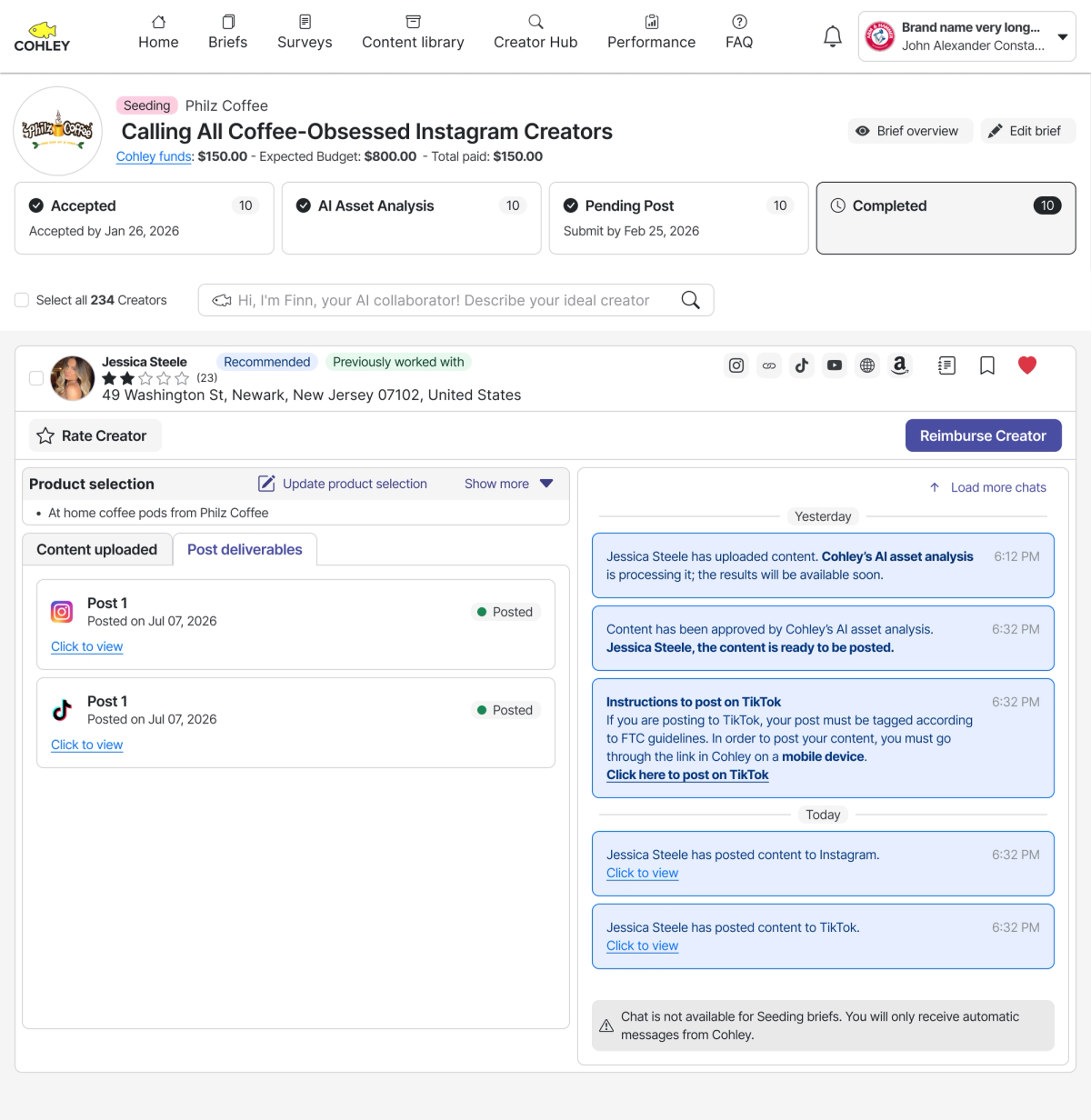
What Product Seeding is: an AI-run product seeding workflow where creators apply to work with your brand, Finn vets each applicant against your criteria, product ships, and every submitted asset is checked against your requirements before publication. Approved content returns with perpetual usage rights. Pricing is $35 per completed post.
Product seeding is one of the highest-ROI motions in creator marketing, and one of the most commonly run wrong. The channel itself is not in question. US social media creator revenue will reach $21.04 billion in 2026, more than doubling since 2022, and 48% of marketers now call creators a must-have investment. The tactic works. The manual way of running it doesn't survive scale.
TL;DR
🚀 Product Seeding is live. AI-run vetting, fulfillment, and asset checks in one workflow.
💸 $35 per completed post. Pay-as-you-go. You pay when a post goes live.
📦 90%+ completion rate versus roughly 30% for typical PR seeding, based on Cohley platform data.
🔍 Every asset checked against your requirements, whether that's 10 assets or 10,000. The FTC holds brands responsible for monitoring the influencers they engage, so unreviewed content at volume is a real liability.
🔁 Rights in perpetuity. Every asset comes cleared for paid and organic.
🛒 Seeding is a retail and discovery lever. Micro- and nano-influencers will claim 45.5% of influencer marketing spending in 2026, and that volume is what drives retail traffic and AI-search visibility.
What Product Seeding does
Finn runs the seeding pipeline so your team runs the strategy.
You define the targeting: category, audience, platform, brand-fit criteria. Creators apply to work with you, and Finn vets each applicant against your criteria before they enter your pipeline. Product ships automatically for Shopify brands, or Finn generates a clean name-and-address export for everyone else. Every submitted asset is checked against your requirements via AI Asset Analysis. Approved content comes back with perpetual usage rights attached.
The vetting isn't guesswork. Cohley's creator matching draws on 1,000+ data points per creator, so "find creators who fit this brand" returns a real shortlist instead of a follower-count sort. Meaning one marketer can run a program that used to take a team.
The five steps, and who does what
- TargetingSet criteria, requirements, volume—
- VettingApprove the approachReviews every applicant against criteria
- Fulfillment—Ships (Shopify) or generates address doc
- Asset checksDefine your requirementsChecks every asset against them
- Rights—Attaches perpetual usage rights
What is product seeding?
Product seeding, also called influencer gifting, is sending free product to creators so they produce authentic content rather than a paid, scripted placement. The creator keeps the product; the brand gets a review, unboxing, or real-use post. It sits distinct from paid influencer campaigns because there's no cash fee per post.
That distinction matters legally as well as commercially. The FTC's Endorsement Guides require disclosure whenever a "material connection" exists between an endorser and a brand, and free product counts as a material connection. The Guides were revised in 2023 for the first time since 2009, expanding the definition of endorsement and adding FTC staff views on brand monitoring of influencers. Gifting does not exempt a brand from disclosure obligations.
Why we built it: seeding works, getting usable content back is the hard part
The first problem is output. Send product to 100 creators and roughly 70 never post. You've paid for 100 units of product and received 30 pieces of content, and you can't plan a launch around a number that soft.
The second is coordination. At 50 creators, someone can manage it by hand. At 300, the vetting, shipping, post-chasing, and asset review turn into a full-time job. At 1,000, it's a team, and most brands don't staff for it. So they cap the program at a size that no longer moves the category, then conclude seeding doesn't work. What didn't work was the absence of a system.
The market has made this harder. Spend is concentrating in exactly the tier that requires volume to matter: micro- and nano-influencers will claim 45.5% of influencer marketing spending in 2026. Over three-quarters (81.5%) of Instagram creators are nano-influencers, and nano-influencers post the highest engagement rate on Instagram at 1.78%, versus 0.33% for mega-influencers with over 1 million followers. Smaller creators perform better per follower, but capturing that advantage means running many more of them at once.
What breaks first when seeding scales?
The review step breaks first. Vetting and shipping are painful but linear. Asset review is where quality quietly collapses.
When a program runs at volume, someone has to check every asset before it goes live… is the product shown correctly, is the disclosure present, is anything off-brand. At 30 assets a person can do it. At 1,000, either the team becomes the bottleneck or the checking stops happening.
The exposure there is not hypothetical. The FTC's revised Guides give staff views on brand monitoring of the influencers they engage, and the agency has proposed rules addressing deceptive reviews and testimonials. Unchecked creator content going live at scale is exactly the brand-safety risk enterprise legal teams raise, and it's the piece "just seed more" advice ignores.
The second thing that breaks is the data. Product ships to a list, arrives as anonymous inventory, and generates no record of who posted, what it drove, or which creators are worth keeping. A program with no measurement can't improve, so year two looks exactly like year one.
Why asset checking is the real scale unlock
The reason enterprise teams can trust a large seeding program is that nothing goes live unchecked. AI Asset Analysis flags content that doesn't meet your pre-defined requirements so only on-brand content gets posted, whether that's 10 assets or 10,000.
But automated checking is only as good as the requirements you write. This is the part brands get wrong. A vague rule can't be enforced by AI or by a human. "Shoot in a natural environment" means something different to every creator. "Make it feel authentic" isn't checkable at all.
Specific rules work:
- Product label must be legible
- Creator says "I'm partnering with [Brand]" in the first 3 seconds
- #sponsored appears in the first 5 seconds of the video
- No competing brand logos in frame
Vague rules don't:
- "Use correct filter insertion" — the system can't know what "correct" means
- "Use royalty-free music" — licensing isn't visually detectable
- "Keep it on-brand" — undefined, so unenforceable
Specificity has a compliance dimension too. The FTC advises that disclosures be clear and conspicuous, and that platform disclosure tools alone may not be sufficient. A requirement like "#sponsored in the first 5 seconds" is checkable; "make sure it's disclosed" isn't.
What brands use seeding for
Seeding isn't one outcome. Three distinct jobs show up most:
Retail traffic. For brands where Amazon or Walmart ranking is a real KPI, creator content driving external traffic contributes to organic rank. Social-driven commerce is scaling fast: TikTok Shop US ecommerce sales are projected to reach $23.4 billion in 2026, a 48% increase year over year, a level at which it would surpass Target, Costco, Best Buy, and Kroger in US ecommerce. Adoption skews young, with 33% of adults ages 18 to 34 having made a purchase on social media, versus 13% of adults 55 to 65. See how this plays out in retail and ecommerce programs.
Content and rights. Every asset generated through Cohley comes with full, perpetual usage rights. No per-piece negotiation, no expiration. That turns a seeding wave into a permanent UGC library you can repurpose across paid and organic. The demand signal supports it: 65% of global shoppers rely on UGC such as ratings, reviews, photos, and videos in their buying decisions, and 80% of Gen Z consider it crucial to their decision-making. Short-form videos (46%) and customer reviews (43%) rank as the most trusted content formats.
Discoverability and AI search. When creators post about a product at volume, they pair your brand name with category language across TikTok, Meta, and YouTube. That footprint is what AI models draw on when surfacing products. The shift is already visible in how shoppers behave: today's shoppers are consulting more sources and conducting more research before committing, prioritizing trust and validation over speed. Authenticity is the filter, and it cuts both ways: 52% of shoppers distrust creator content that feels overly promotional, while 52% cite real customer reviews as the biggest factor in their final purchase decisions.
Who it's for (and who it isn't)
Product Seeding fits enterprise DTC and CPG brands, roughly $30M+ in revenue, running creator, social, or retail programs where volume actually matters. If you're seeding a few dozen creators a year for a single launch, the manual approach is fine and this is more machine than you need.
It fits best when at least one of these is true: you're supporting a product launch that needs real content volume, Amazon or Walmart ranking is a tracked KPI, or you want a rights-cleared content library without negotiating per asset. If none of those describe you, seeding at scale isn't your bottleneck yet. Our case studies show what these programs look like in practice.
Pricing
Product Seeding is $35 per completed post, pay-as-you-go. You pay when a post goes live, not per send and not per application. Product costs sit outside that, budgeted to your retail value and volume. Spend tracks to results, so you can scale up for a launch and adjust as your program changes. Full detail on plans.
FAQ
- What is the new Product Seeding feature?
Product Seeding is Cohley's AI-run seeding workflow. Finn vets creators against your criteria, manages fulfillment, and checks every submitted asset against your requirements before it goes live. Your team sets strategy and requirements; Finn handles the repetitive execution. Pricing is $35 per completed post.
- What is product seeding?
Product seeding, also called influencer gifting, is sending free product to creators so they create authentic content, such as a review, unboxing, or real-use post, rather than a paid, scripted placement. The goal is genuine advocacy and reusable content, not a one-off sponsored post.
- What's a good product seeding completion rate?
Most PR-style seeding programs see around 30% of gifted creators actually post. Anything meaningfully above that signals a managed program with vetting and follow-up rather than ship-and-hope. Cohley seeding runs at a 90%+ completion rate based on platform data.
- Do gifted creators have to disclose?
Yes. The FTC's Endorsement Guides require disclosure whenever a material connection exists between an endorser and a brand, and free product qualifies. Follower count is irrelevant. The brand shares responsibility, which is why disclosure requirements should be written into every brief.
- How many creators do you need to seed for it to work?
It depends on the goal, but the bar has risen as spend concentrates in smaller creators. Micro- and nano-influencers will claim 45.5% of influencer marketing spending in 2026. Content-generation waves can be smaller; awareness and category-share waves run broader.
- Do you keep the rights to seeded content?
With Cohley, yes. Every asset comes with full, perpetual usage rights, so you can repurpose seeded content across paid media and organic channels with no additional negotiation or expiration. That's what turns a seeding wave into a lasting content library.
- What makes seeding fail at scale?
Two things break first: asset review, since checking everything by hand becomes impossible past a few hundred creators, and measurement, since product shipped with no tracking generates no data. Both are execution gaps, not flaws in seeding itself.
Related posts
- Jul 28, 20268 min read
Does Product Seeding Help You Show Up in AI Search?
An honest look at whether creator content influences AI-generated product recommendations — what the mechanism is, what the evidence supports, and what it doesn't.
 Zach Chmael
 - Jul 28, 20268 min read
How to Write Creator Content Requirements That Actually Work
Vague requirements produce change requests. Specific, observable ones produce usable content the first time. Here's how to write non-negotiables that hold up.
Zach Chmael
Ready to seed at scale?
Set up your first program in your account: scope creator volume, targeting, timing, and requirements, then launch when you’re ready. Want a hand? Your CSM can help you scope it.